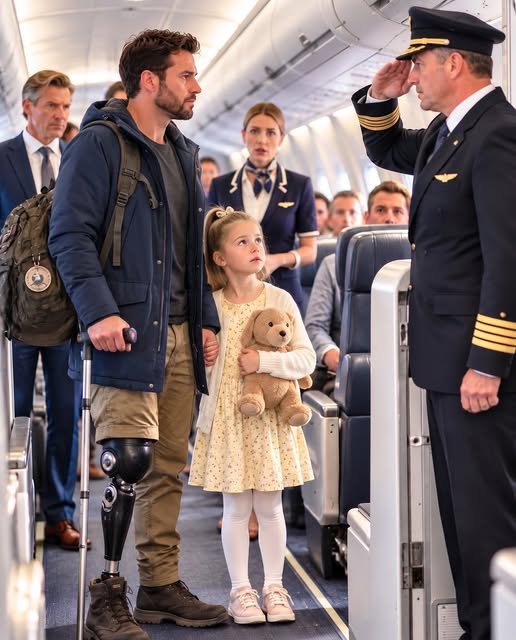
“Vance,” the captain said again, quieter now. “Marcus Vance. Third Battalion, the convoy outside Kandahar, the night of the ambush.”
My throat tightened. “Yes, sir.”
“Sergeant Vance.” He swallowed. “You don’t remember me. Why would you? I was in the back of a medevac helicopter, with a tourniquet on my arm and a hole in my flight suit. You were the one who dragged me out of the burning cab.”
The cabin was so silent I could hear the air vents.
I did remember a night, though not a face. Eleven years earlier, a Black Hawk had gone down hard outside a supply route. I was a staff sergeant then, with two good legs and a radio on my shoulder. We reached the wreck before the fire reached the fuel. I pulled three men out. Two of them lived.
“Captain Daniel Ross,” he said. “Then I was Lieutenant Ross, a helicopter pilot. I woke up in a hospital in Germany. They told me a sergeant named Vance had gone back in for me twice. The second time, the cab collapsed on his leg.”
I looked down at my prosthetic, hidden under my pant leg. He followed my gaze, and his face tightened.
“I looked for you for years,” he said. “I wrote to the Army. I called veterans’ groups. I was told your records were sealed. After a while, I assumed I’d never find you.”
“I never knew you were looking,” I said.
“And now you’re on my plane,” he said, his voice cracking, “with your daughter, and somebody tried to put you in the back.”
He turned to the gate agent, who was standing very still, tablet at his side.
“Mr. Harlan,” the captain said evenly. “You will take this passenger’s seat assignment and confirm it in writing. You will then apologize.”
Harlan flushed. “Captain, the other gentleman is a platinum traveler. Corporate policy says…”
“Corporate policy,” Ross said, “does not allow the removal of a ticketed passenger without cause. You didn’t have cause. You had a judgment about the way they looked.”
The businessman in the navy suit shifted. He had been staring at the carpet. Now he spoke, thick and awkward.
“Captain, I didn’t ask for anyone to be moved. The agent told me there was a mix-up.”
“Then you’ll be glad to know there’s a seat for you in row nine,” Ross said. “Aisle, with extra legroom. The agent will arrange it.”
The man swallowed and gave a small, stiff nod. To his credit, he stepped toward me.
“Sir,” he said quietly. “I’m sorry. I should have asked what was going on.”
“Thank you,” I said, and meant it.
Harlan apologized in a low, tight voice. Ross waited until he’d finished, then turned back to me.
“Mr. Vance, would you and your daughter please take your seats? I’d like to speak with you after landing.”
I lowered myself into seat 2A, and Maya climbed into 2B, wide-eyed.
“Daddy,” she whispered. “Why did the pilot salute you?”
I tried to find the right words for a seven-year-old. “A long time ago, I helped someone who was in trouble. He remembered.”
“Like a superhero?”
“No, baby. Just a soldier.”
She considered this. “I think soldiers are the real superheroes.”
I laughed, and my eyes stung.
The flight was smooth. Halfway across the Carolinas, a flight attendant named Priya knelt beside Maya with a tray.
“Your captain asked me to bring you something special,” she said. On it sat a small cake with a single candle, and a card in the captain’s handwriting.
To Maya, who is the bravest passenger on my flight. Welcome aboard. Captain Ross.
Maya stared. “Is it my birthday?”
“No,” Priya said gently. “But he wanted you to have it.”
Maya blew out the candle anyway. When she looked up, her cheeks were pink.
“I wished for Mama to see the ocean,” she whispered.
I put my hand over hers. I couldn’t speak.
We landed at dusk. Ross waited at the jet bridge in his pressed uniform, cap tucked under his arm. He shook my hand with both of his.
“I want to ask you something,” he said. “I don’t want to intrude.”
“Ask.”
“Where are you headed?”
I told him. The beach. Elena. The little container in my bag. He listened without a flicker of discomfort.
“I live twenty minutes from there,” he said. “My wife and I would be honored to drive you. And if you’d like, we’d stand with you. Quietly. Or not at all, if you’d rather be alone.”
I had not planned for company. But something in his face, a loyalty held over eleven years, made me say yes.
We reached the shore as the sun was going down. The sky was the color of peaches. The tide was out, and the sand shone like glass.
Maya walked ahead, barefoot, her pink coin purse swinging at her wrist. Ross and his wife, Anne, stood a respectful distance behind me. I carried the container to the water’s edge.
“Maya,” I said. “Do you want to help?”
She nodded. We knelt together in the wet sand, and I opened the lid. Maya’s small hands covered mine.
“Goodbye, Mama,” she said, steady and clear. “We brought you back to the ocean like you wanted. You can stay here now.”
I tipped the container, and the water took it, gentle and quick. A wave rolled in. Another followed. The ashes swirled and spread and were gone.
I stayed on my knees. Maya leaned against me, and neither of us spoke. Behind us, I heard Anne crying softly. When I looked back, Ross stood at attention, one hand raised in salute, facing the water.
I realized he wasn’t saluting me. He was saluting Elena.
Later, on the sand with a thermos of coffee Anne had brought, Ross told me what he’d been carrying.
“There’s something I’ve wanted to do for eleven years,” he said. “Two things. The first is small.”
He took a worn envelope from his jacket. Inside was a check, made out to the Mama’s Beach Fund, though he couldn’t have known the name. He’d written it from instinct, to a veterans’ children’s scholarship in my daughter’s name.
“It’s a college fund,” he said. “For Maya. Anne and I set it up years ago, in your honor, hoping we’d find you. It’s been growing. It’s yours.”
I stared at the number. My hands shook.
“I can’t take this.”
“You already did,” Ross said quietly. “You gave me my life. This is only interest.”
I looked at Maya, who was drawing in the wet sand with a shell.
“What’s the second thing?”
He smiled. “The airline has a veterans’ program. We hire disabled veterans in operations and customer service, and we’re always short on people who understand. Your record is clean. Your leadership is documented. I’d like to recommend you for a position, Mr. Vance. Nothing that costs you more than you can give.”
I thought of the coffee can on the refrigerator. The night shifts. The weeks of twenty dollars.
“Let me think,” I said.
“Take your time,” he said. “The offer doesn’t expire.”
I took the job in the spring.
I work now in the training department, teaching new gate agents how to treat every passenger as if they might one day be someone’s captain. I tell them about the man who tried to move a father and daughter because of how they looked. I don’t use names. I just say: You never know what a person is carrying.
Maya is eight now. She keeps the cake card on her bedroom wall. On the refrigerator, the coffee can still sits, though it holds only a few coins and a note: For the next time we visit Mama.
We go back every year. Sometimes Ross and Anne meet us. We watch the sun go down over the water, and Maya runs along the edge, waving at the waves.
“Hi, Mama,” she calls. “We’re here.”
The wind lifts her hair, and the tide answers, steady and warm, as if somebody on the far side of it is listening.
I stand on the sand, and I salute the ocean, one hand to my brow.
For two years, I thought the hardest thing I’d ever do was keep a promise.
I was wrong. It was letting the world see us keep it.