PART 2
My phone vibrated seventeen times before I finally turned it over.
Twelve missed calls from Mark. Three from Hannah. Two from numbers I didn’t recognize. There were also so many Facebook notifications that I couldn’t read them all without scrolling.
Arthur glanced up from his cup of spiced cider.
“Everything all right, Linda?”
I looked at the photograph I’d posted.
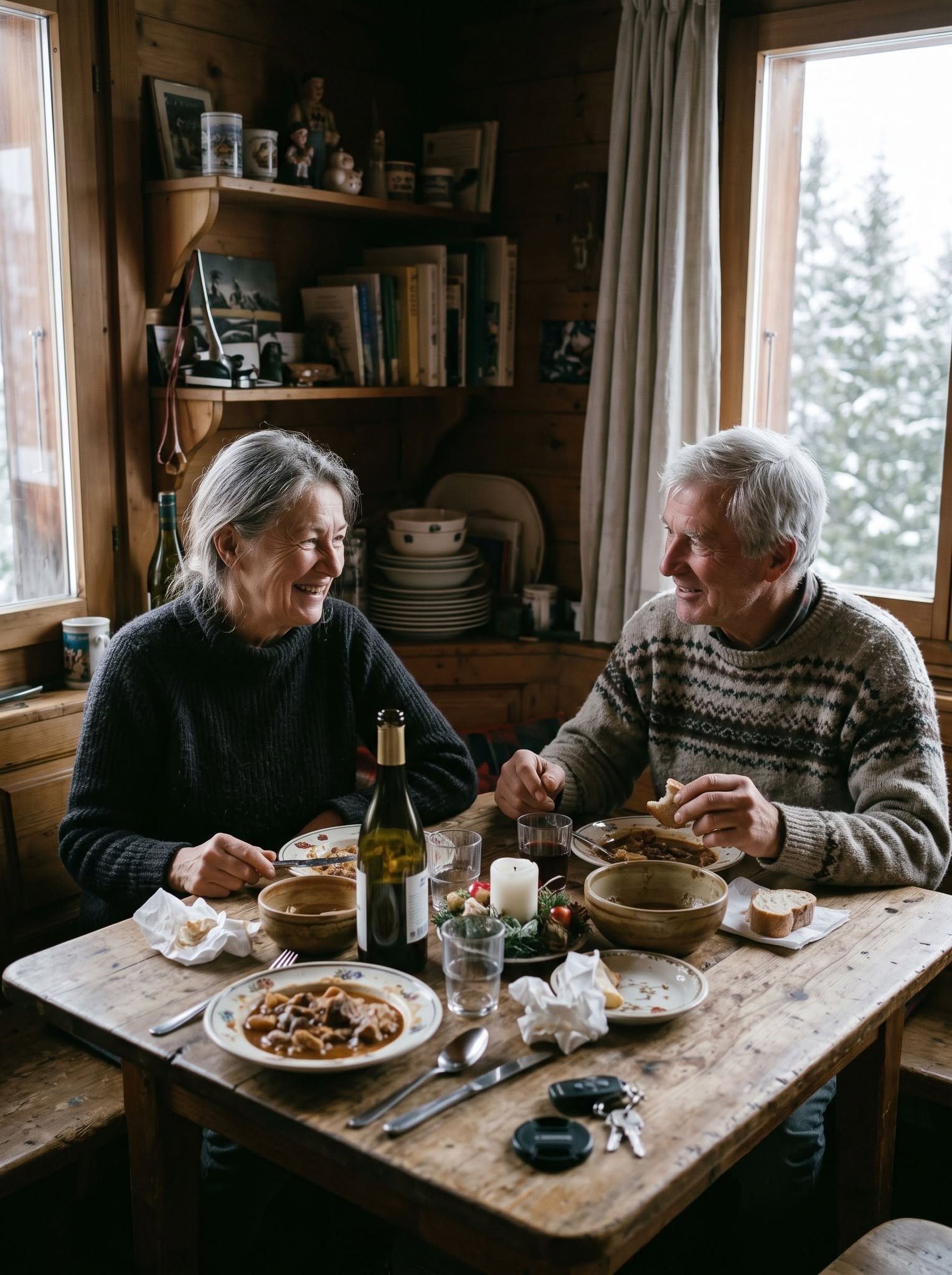
There we were, sitting together in a little Swiss chalet, surrounded by Christmas lights and snow-covered mountains. Arthur was wearing the ridiculous Tyrolean hat he’d bought in Austria. I was laughing so hard that my eyes were nearly closed.
I looked happy.
Not politely happy, the way I smiled for family photographs when I was tired and wanted to go home.
Actually happy.
I couldn’t remember the last time I’d looked like that.
“My son just discovered I’m in Europe,” I said.
Arthur raised an eyebrow.
“You didn’t tell him?”
“He didn’t ask what I was doing for Christmas.”
Arthur set down his cup. He didn’t laugh or tell me that my family sounded terrible. That was something I was beginning to appreciate about him. He listened before deciding what to say.
“Would you like some privacy to call him?”
I thought about it.
Then I looked through the chalet window.
Snow was falling beyond the wooden railing. The mountains rose in the distance, their peaks silver beneath the afternoon sky. Inside, the room smelled of cinnamon, roasted chestnuts, and pine.
For the first time in eight years, I wasn’t sitting alone at Christmas, pretending to enjoy a television special while wondering whether my son would remember to call.
I smiled.
“Not just yet.”
Arthur nodded.
“Then I’d suggest we order dessert.”
And for the next forty minutes, that’s exactly what we did.
The first message I read that evening was from Mark.
Mom, where are you?
The second arrived six minutes later.
Are you actually in Switzerland?
Then came a third.
Who is that man sitting next to you?
I stared at those words.
For years, Mark had known almost everything about my routine.
I went grocery shopping on Thursdays. I attended church most Sundays. I volunteered twice a month at the library. I had coffee with my neighbor, Carol, on Wednesday mornings.
Whenever he called, I was usually home.
If I wasn’t home, he knew where I was likely to be.
And now, suddenly, his sixty-seven-year-old mother was thousands of miles away, smiling beside a handsome stranger.
Apparently, that was enough to cause a family emergency.
I opened Hannah’s messages.
Linda, are you traveling with a man?
Mark is worried sick.
You should have told us you were leaving the country.
The next message made me pause.
This is very unlike you.
I read it twice.
Unlike me.
I supposed it was.
The old Linda would have accepted being excluded from Christmas, told everybody she understood, and spent the holiday alone.
The old Linda would have baked the pecan pie anyway, wrapped it carefully, and taken it to Mark and Hannah’s house a few days later.
She would have pretended that nothing hurt.
But that woman had spent eight years waiting for life to begin again after Paul died.
And somewhere between the Christmas markets of Munich and the snowy streets of Salzburg, I had begun wondering why.
I typed a message to Mark.
I’m safe, sweetheart. I’m on an organized Christmas tour. I’m having a wonderful time. We’ll talk tomorrow.
Then I switched off my phone.
Not because I wanted to frighten anyone.
But because I was finally learning that being somebody’s mother didn’t mean I had to answer every demand the moment it arrived.
The next morning, I woke to the sound of church bells.
For a moment, I forgot where I was.
Then I opened the curtains and saw the Swiss mountains.
The sun was rising over the snow, turning everything pale gold.
I sat on the edge of the bed and began crying.
Not because I was unhappy.
Because Paul should have seen this.
My husband loved mountains.
When we were first married, he kept a calendar of Switzerland in our little apartment kitchen. Every month showed another village, another lake, another mountain range.
He used to point toward the photographs while I washed dishes.
“One day, Linda, we’re going there.”
I would laugh.
“With what money?”
He’d grin.
“We’ll figure it out.”
But there was always something else.
The mortgage.
Mark’s school expenses.
Repairs to the car.
My mother’s medical bills.
Then Paul’s health began deteriorating.
And eventually, the trip became something we talked about less often because we both knew it probably wasn’t going to happen.
When he died eight years earlier, I put that calendar away with his belongings.
I couldn’t bear to look at it.
Now I was sitting in Switzerland, watching the sun rise over the very mountains he’d dreamed of seeing.
I pressed my hand against the window.
“Oh, Paul,” I whispered. “I finally made it.”
For a long time, I sat there.
Then my phone rang.
Mark.
This time, I answered.
“Good morning, sweetheart.”
“Mom!”
His voice was so loud I pulled the phone away from my ear.
“Where have you been? I’ve been calling all night!”
“I know.”
“Are you really in Switzerland?”
“Yes.”
“With some man?”
I closed my eyes.
“Mark, I’m on a Christmas tour.”
He sounded incredulous.
“You just decided to fly to Europe?”
“Yes.”
“By yourself?”
“Yes.”
“And you didn’t think you should tell me?”
I looked toward the mountains.
“Mark, I’m sixty-seven years old. I’m perfectly capable of booking a holiday.”
There was silence.
Then he said something that made my chest tighten.
“Mom, who is he?”
I sat down.
“His name is Arthur.”
“Arthur who?”
“Arthur Whitmore. He’s a retired architect from Boston.”
“How do you know him?”
“We met on the plane.”
Mark went completely quiet.
Then he said, “You met some random man on a plane and now you’re spending Christmas with him?”
I almost laughed.
“That’s a rather dramatic way of describing it.”
“Mom, this isn’t funny.”
“No,” I said calmly. “It isn’t.”
I took a breath.
“Arthur is traveling with the same tour group. We’ve become friends. He’s a widower, and he’s been very kind.”
Mark exhaled.
“Mom, you barely know him.”
“That’s true.”
“Then why are you posting photographs with him?”
I looked at the picture again.
Because I liked the way I looked in it.
Because I wanted to remember being happy.
Because for once, I hadn’t thought about whether someone would approve.
“Because I wanted to,” I replied.
Another silence followed.
Then Mark said quietly, “Mom, what’s going on?”
Something about his voice made me stop.
He sounded less angry now.
More confused.
For a moment, I saw him as the little boy who used to come into the kitchen after having a nightmare.
I softened.
“Mark, I’m having a Christmas holiday.”
“But you always spend Christmas with us.”
I looked toward the snow.
“Not this year.”
He hesitated.
Then said, “Hannah told me you understood.”
I closed my eyes.
“I told her I understood what she’d decided.”
“That’s not the same thing?”
“No, sweetheart.”
I let the silence settle.
Then I asked a question.
“Mark, when Hannah told you I wasn’t coming for Christmas, did you ever ask whether I wanted to spend the day alone?”
He didn’t answer.
I waited.
Finally, he whispered, “No.”
My throat tightened.
I continued.
“Did you invite me somewhere else?”
Silence.
“Did you suggest Christmas Eve? Or breakfast? Or perhaps coming to see me before the holiday?”
He sighed.
“Mom…”
I swallowed.
“Or did you simply assume I’d be fine sitting at home?”
He didn’t speak.
Then he said something I wasn’t expecting.
“I thought you liked quiet Christmases.”
I stared at the phone.
“Why would you think that?”
“Because you always say you’re fine.”
I closed my eyes.
There it was.
The sentence I’d repeated so often that everyone had begun believing it.
I’m fine.
When I spent the first Christmas after Paul’s death eating dinner alone.
I’m fine.
When Mark and Hannah canceled our Sunday plans because something came up.
I’m fine.
When I sat in an empty church pew on the anniversary of Paul’s death because neither of them remembered the date.
I had said those words every time.
And now, apparently, they had become permission not to think about me at all.
“Mark,” I whispered, “sometimes mothers say they’re fine because they don’t want their children to feel guilty.”
He became very quiet.
I continued.
“That doesn’t mean they’re not lonely.”
His breathing changed.
For a moment, I thought he was crying.
Then he whispered, “Mom, I didn’t know.”
I wiped my eyes.
“I know, sweetheart.”
And that was precisely the problem.
Arthur found me in the hotel dining room an hour later.
He was carrying two cups of coffee.
“Good morning, Linda.”
I smiled.
“Morning.”
He set one cup in front of me.
“Cream, no sugar. Have I remembered correctly?”
I laughed softly.
“You have.”
He sat across from me.
For a few minutes, we talked about the day’s itinerary.
A train ride through the mountains.
A visit to a lakeside village.
Dinner with the rest of the tour group.
Then Arthur looked at me carefully.
“Your son?”
I nodded.
“We talked.”
“How did it go?”
I considered the question.
“Painfully.”
He smiled sadly.
“Those are sometimes the conversations that matter.”
I looked at him.
“You sound like Paul.”
Arthur’s expression softened.
“Your husband?”
I nodded.
“He used to say difficult conversations were like overdue repairs. Waiting only made them more expensive.”
Arthur laughed.
“As an architect, I can confirm that.”
I laughed too.
Then something strange happened.
I began crying.
Right there at breakfast.
I tried to apologize, but Arthur gently pushed a napkin toward me.
“Nothing to apologize for.”
I wiped my eyes.
“It’s just that Paul and I always wanted to come here.”
Arthur waited.
“He died before we could.”
My voice broke.
“And for eight years, I couldn’t imagine taking the trip without him.”
Arthur looked toward the window.
Then said quietly, “My wife was named Margaret.”
I nodded.
He’d told me about her on the plane.
“We were married forty-four years,” he continued. “She loved Christmas more than anyone I’ve ever known.”
He smiled.
“She’d put decorations up before Thanksgiving if I didn’t stop her.”
I laughed through my tears.
“Paul used to complain that I did the same thing.”
Arthur looked down at his coffee.
“After Margaret died, I stopped decorating altogether.”
His voice became quieter.
“The first Christmas, I told everyone I wanted to be alone. The second, I said the same thing.”
I watched him.
“Then this year, I realized I hadn’t actually wanted to be alone.”
He smiled sadly.
“I’d just been afraid of discovering how different Christmas felt without her.”
My throat tightened.
Arthur continued.
“So I booked this tour.”
He looked at me.
“And then I met a woman on the plane who insisted she was perfectly fine traveling alone, even though she spent the first twenty minutes gripping the armrest.”
I burst out laughing.
“I was not gripping it.”
“You nearly removed it from the aircraft.”
I laughed so hard I started crying again.
And for the first time since Paul died, I realized something.
I could miss my husband terribly and still enjoy being alive.
Those two feelings didn’t cancel each other out.
That afternoon, Mark called again.
I was standing near a Christmas market when his name appeared on my screen.
Arthur had stepped inside a shop to look at handmade ornaments.
I answered.
“Hello, sweetheart.”
“Mom, can we talk?”
His voice sounded different.
Tired.
Serious.
“Of course.”
He took a breath.
“I spoke with Hannah.”
I waited.
“And?”
He sighed.
“She says you never told us you were upset.”
I looked toward the market stalls.
“No, I didn’t.”
He hesitated.
“Why not?”
I considered that.
Then answered honestly.
“Because I didn’t want to be the mother-in-law who demanded every holiday.”
He was quiet.
I continued.
“Hannah has a mother. I understand that she wants to spend Christmas with her. I don’t expect every holiday to revolve around me.”
Mark exhaled.
“Then what’s the problem?”
My heart sank a little.
I took a breath.
“Mark, there is a difference between choosing to celebrate Christmas at Hannah’s mother’s house and telling your widowed mother she should stay home alone.”
Silence.
“You could have invited me along.”
He didn’t answer.
“You could have asked whether I had other plans.”
More silence.
“You could have said, ‘Mom, we’d love to see you on Christmas Eve.’”
His voice cracked.
“I know.”
I continued.
“But nobody asked.”
For a moment, I couldn’t speak.
Then I whispered, “I have spent eight years trying not to become a burden to you.”
Mark began crying.
“Mom, you’re not a burden.”
I smiled sadly.
“Then perhaps we should stop arranging our holidays as though I am.”
He didn’t answer.
And for once, I didn’t rush to comfort him.
I let him sit with what I’d said.
After a while, he whispered, “I’m sorry.”
I closed my eyes.
“Thank you.”
He swallowed.
“Can we do Christmas when you get home?”
I looked toward the market.
Arthur was emerging from the shop carrying a small paper bag.
I smiled.
“We can talk about making plans.”
Mark sounded surprised.
“Talk about it?”
“Yes, sweetheart. I haven’t decided what I’m doing yet.”
There was a pause.
Then he said something that made me smile.
“Okay, Mom.”
I knew it wasn’t much.
But for the first time in years, my son had accepted that I might have plans of my own.
The following day, I received a message from Hannah’s mother.
Her name was Judith.
We’d never been particularly close, but we’d always been polite.
Linda, I had no idea you weren’t invited to Christmas. I thought you were staying home because you weren’t feeling well. I’m sorry.
I stared at the message.
Then read it again.
Not feeling well?
I called Judith that evening.
She answered immediately.
“Linda! Oh, my goodness. Switzerland!”
I laughed softly.
“Yes.”
“You look wonderful in those photographs.”
“Thank you.”
She hesitated.
“May I ask you something?”
“Of course.”
“Did Hannah actually tell you not to come?”
I took a breath.
“She told me they were having Christmas at your house and that I could stay home and relax.”
Judith went quiet.
Then said something I wasn’t expecting.
“Linda, I would have set another place at the table.”
My eyes filled.
She continued.
“I had fourteen people for dinner. Fifteen wouldn’t have made a difference.”
I pressed a hand against my chest.
“Thank you, Judith.”
She sighed.
“Hannah told me you wanted a quiet holiday.”
I looked down.
“That’s what Mark thought too.”
Judith was quiet.
Then she said firmly, “Well, somebody should have asked you.”
I laughed through my tears.
“Yes.”
She softened.
“And as for that gentleman in your photograph…”
I smiled.
“Arthur.”
“Yes. Arthur.”
Her voice became playful.
“He’s rather handsome.”
I laughed.
“He is.”
Judith chuckled.
“Good for you, Linda.”
For the first time, I felt genuinely fond of my daughter-in-law’s mother.
Then she added, “And next time we have Christmas at my house, I hope you’ll come. You won’t have to bring a pie, either.”
My eyes filled.
“I’d like that.”
After we hung up, I sat for a long time looking at the phone.
I had spent years thinking there was only room for one mother at the Christmas table.
Apparently, the only people who believed that were the ones deciding who should be invited.
On the final evening of the tour, Arthur and I went for a walk through a small Swiss village.
Christmas lights hung over the street.
Snow rested on rooftops.
The shop windows glowed with candles.
We walked slowly because Arthur had a troublesome knee and I wasn’t particularly interested in slipping on ice.
At one point, he offered his arm.
I took it.
It felt strange.
For eight years, I’d avoided even the smallest things that reminded me of being married.
Walking arm in arm.
Sharing dessert.
Having someone carry my suitcase.
Not because I believed Paul would have objected.
Because those things reminded me of how much I’d lost.
Now, walking beside Arthur beneath the Christmas lights, I felt something I hadn’t expected.
Comfort.
He didn’t remind me of Paul in every way.
Paul was loud and impulsive.
Arthur was thoughtful and gentle.
Paul loved fishing.
Arthur loved architecture.
Paul couldn’t draw a straight line to save his life.
Arthur had spent forty years designing buildings.
They were different men.
And perhaps that was why I felt safe getting to know Arthur.
I wasn’t trying to replace my husband.
I was simply discovering that the world still contained people I might enjoy spending time with.
We stopped beside a shop window.
Inside was a display of miniature wooden houses.
Arthur studied them.
Then smiled.
“Margaret would have loved those.”
I looked at him.
“Paul would’ve tried to build one himself.”
Arthur laughed.
Then he grew quiet.
“Linda, may I ask you something?”
I nodded.
“Of course.”
“When we return home, would you be comfortable staying in touch?”
My heart began beating a little faster.
I looked toward him.
He continued.
“No expectations. No grand promises. I live in Boston, you live several states away, and we’ve known one another less than two weeks.”
I smiled.
“But?”
He looked slightly embarrassed.
“But I enjoy talking to you.”
My throat tightened.
“And I’d be disappointed if this friendship ended at the airport.”
For a moment, I couldn’t speak.
Then I smiled.
“I’d be disappointed too.”
Arthur looked relieved.
He offered his arm again.
And we continued walking.
It wasn’t a proposal.
It wasn’t a declaration of love.
It was something smaller.
And at sixty-seven, after eight years of believing the best part of my life was behind me, smaller was more than enough.
I returned home on December 30.
Mark was waiting at the airport.
I’d told him he didn’t need to come.
He insisted.
When I stepped through the arrivals area, I saw him standing beside a pillar, holding a small bunch of flowers.
He looked nervous.
The sight made my chest tighten.
My son was forty-one years old, but for a moment, I saw the little boy who used to wait at the front window when I came home from work.
“Mom!”
He hurried toward me.
Then stopped when he saw Arthur walking beside me.
Arthur smiled politely.
“Hello.”
Mark looked between us.
For a moment, he seemed unsure what to do.
Then he extended his hand.
“I’m Mark.”
Arthur shook it.
“Arthur Whitmore. Nice to meet you.”
Mark studied him.
Then said something that made me want to disappear into the floor.
“So you’re the guy from Facebook.”
Arthur laughed.
“I suppose I am.”
I closed my eyes.
“Mark.”
“What?”
Arthur smiled.
“It’s all right, Linda. I’ve been called worse.”
Mark laughed awkwardly.
Then looked at me.
“Mom, can I take your suitcase?”
I hesitated.
Then smiled.
“Of course.”
He took it.
Arthur’s connecting flight to Boston was leaving a few hours later.
Before we parted, he turned toward me.
“I’ll call when I get home.”
I nodded.
“Please do.”
Then he leaned forward and kissed my cheek.
A gentle, brief kiss.
Nothing dramatic.
But enough to make my son’s eyes widen.
Arthur smiled.
“Safe travels, Linda.”
“You too.”
Then he walked away.
I watched him disappear into the crowd.
When I turned back, Mark was staring at me.
“What?” I asked.
He blinked.
“Mom.”
“Yes?”
“Are you dating him?”
I laughed.
“I don’t know.”
He looked horrified.
“What do you mean, you don’t know?”
I smiled.
“It means we’re getting to know each other.”
Mark stared at me.
Then he said something that surprised me.
“Dad would’ve liked him.”
I went still.
“What?”
Mark looked toward the crowd.
“He seems decent.”
My eyes filled.
I swallowed.
“Thank you, sweetheart.”
And for the first time since returning, I felt something in the space between us begin to soften.
On the drive home, Mark was unusually quiet.
Normally, he filled silence with stories about work or complaints about traffic.
This time, he kept glancing toward me.
Finally, I asked, “Is something bothering you?”
He took a breath.
“Mom, I owe you an apology.”
I looked at him.
He continued.
“Not because you went to Switzerland.”
I smiled faintly.
“Good.”
He swallowed.
“Because you felt like you had to leave the country to have a Christmas you actually enjoyed.”
My throat tightened.
“Mark, I didn’t have to leave.”
He nodded.
“I know.”
Then he added, “But I think I made it easier for you to feel forgotten than to feel wanted.”
I looked out the window.
That was closer to the truth than he realized.
He continued.
“After Dad died, you were always the one checking on me.”
I swallowed.
“You’d call to ask how work was going.”
He nodded.
“You’d bring food. Remember birthdays. Come to the house whenever we invited you.”
His voice cracked.
“And somewhere along the way, I stopped thinking about whether anybody was taking care of you.”
Tears filled my eyes.
I wiped them quickly.
Mark noticed.
“Mom, I’m sorry.”
I looked at him.
Then said quietly, “I appreciate that.”
He swallowed.
“I don’t want you thinking we don’t need you.”
I took a breath.
“Mark, I don’t need to be needed all the time.”
He glanced toward me.
I continued.
“I want to be wanted.”
His eyes filled.
And for the rest of the drive, neither of us said much.
But the silence felt different.
Not uncomfortable.
Thoughtful.
Hannah came to see me two days later.
She brought a pecan pie.
That made me laugh.
For years, I’d been the one arriving at their house carrying dessert.
Now my daughter-in-law stood on my porch holding a pie from the bakery.
“Linda,” she said nervously, “can we talk?”
I stepped aside.
“Of course.”
We sat at my kitchen table.
The Christmas decorations were still up.
My tree stood beside the window.
Paul’s old ornaments hung from the branches.
Hannah looked around.
Then said quietly, “You have a beautiful tree.”
“Thank you.”
She looked down at the pie.
For a moment, neither of us spoke.
Then she took a breath.
“I handled Christmas badly.”
I waited.
She continued.
“I should have invited you to my mother’s house.”
I nodded.
“Yes.”
“And I shouldn’t have assumed you’d be happy spending the holiday alone.”
My throat tightened.
She looked up.
“I’m sorry.”
I studied her.
For years, I’d wondered whether Hannah actually disliked me.
She was never openly cruel.
But she was often impatient.
She rarely called unless she needed something.
And whenever holidays came around, she seemed to treat me as an extra obligation that had to be fitted into an already crowded schedule.
I took a breath.
“Hannah, can I ask you something?”
She nodded.
“Of course.”
“Do you dislike having me around?”
Her face changed.
“What?”
I looked down.
“Sometimes I feel as though I’m in the way.”
She stared at me.
Then began crying.
“Oh, Linda.”
I waited.
She wiped her eyes.
“I don’t dislike you.”
“Then why does it sometimes feel that way?”
She looked down.
For a long time, she didn’t answer.
Then she whispered, “Because I think I’ve been selfish.”
I remained quiet.
She continued.
“My mother lives alone too, and she gets upset when we don’t spend holidays with her.”
I nodded.
“I understand.”
“And I feel like I’m constantly trying to keep everybody happy.”
Her voice broke.
“So when I started planning Christmas, I decided we’d go to her house this year.”
I nodded.
“That part was reasonable.”
She looked surprised.
I continued.
“I’m not angry that you wanted to spend Christmas with your mother.”
Her eyes filled.
“Then what—”
“I’m hurt that you told me to stay home without asking what I wanted.”
She lowered her head.
I continued.
“Hannah, I would have understood if you’d said, ‘Linda, we’re spending Christmas at Mom’s. Would you like to join us? Or could we make plans for another day?’”
She began crying harder.
“But you didn’t.”
She nodded.
“I know.”
I took a breath.
“And Mark didn’t either.”
She wiped her eyes.
“He should have.”
“Yes.”
For a moment, we sat quietly.
Then Hannah said something unexpected.
“I think I took your kindness for granted.”
I looked at her.
She continued.
“You always brought the pie.”
I smiled sadly.
“Yes.”
“You always said you understood.”
“Yes.”
“You never complained when we changed plans.”
I looked down.
She swallowed.
“And I think I started believing you really didn’t mind.”
I took a slow breath.
“Hannah, I’ve spent a lot of years trying not to make anyone feel guilty for living their own life.”
She nodded.
“But that doesn’t mean I don’t want to be included in it.”
Tears slipped down her cheeks.
“I know.”
I reached for her hand.
“I don’t need every Christmas.”
She smiled through her tears.
“I know.”
“I don’t need to sit at the head of the table.”
She laughed softly.
“And I certainly don’t need anyone rearranging their entire life for me.”
Hannah wiped her eyes.
“Then what do you need?”
I thought about it.
Then answered honestly.
“An invitation sometimes.”
My voice broke.
“And a little consideration.”
She covered her mouth.
Then she stood, walked around the table, and hugged me.
I hugged her back.
It didn’t solve everything.
But it was a beginning.
Over the following months, my life changed in ways I hadn’t expected.
Arthur called when he reached Boston.
Then again the following week.
At first, we talked about the trip.
The Christmas markets.
The mountain villages.
The ridiculous hat he’d bought.
Then we began talking about ordinary things.
His garden.
My volunteer work.
The books we were reading.
The strange things people say when they discover you’re older and living alone.
Sometimes we spoke for ten minutes.
Sometimes an hour.
He never made me feel as though I was taking up too much of his time.
And he never made me feel guilty if I was busy.
In March, he invited me to visit Boston.
I hesitated.
Then booked a ticket.
I stayed at a hotel near the harbor.
Arthur showed me around the city.
We visited museums.
Ate seafood.
And spent an entire afternoon walking through neighborhoods where he’d designed or restored buildings.
He pointed out windows, rooflines, and details I would never have noticed.
I teased him.
“Arthur, most people just look at a building and decide whether it’s pretty.”
He laughed.
“Most people are missing a lot.”
Then he stopped beside an old brick church.
He looked toward the stained-glass windows.
“Margaret loved this place.”
I stood beside him.
He continued.
“She used to come here when she needed to think.”
I took his hand.
For a moment, he looked surprised.
Then he squeezed it gently.
And we stood quietly together.
There was no need to pretend our previous marriages hadn’t existed.
Paul and Margaret were part of our lives.
They always would be.
We weren’t trying to erase them.
We were simply discovering that our stories might still have another chapter.
By summer, Mark had begun changing too.
He called more often.
Not because he needed something.
Just to talk.
Sometimes he invited me to lunch.
Sometimes he and Hannah came to my house for dinner.
And sometimes I declined because I already had plans.
The first time that happened, Mark sounded genuinely shocked.
“Mom, you’re busy?”
I laughed.
“Yes.”
“Doing what?”
“Having dinner with Carol and some friends.”
He paused.
“Oh.”
Then he laughed.
“Okay. Have fun.”
I smiled.
“I intend to.”
It was such a small thing.
But it mattered.
For years, my availability had been taken for granted.
Now my son was learning that I had a life that continued even when he wasn’t looking.
Hannah also made more of an effort.
She invited me to family gatherings without assuming I’d automatically come.
She asked about Arthur.
And when I told her he was visiting in September, she surprised me.
“Would you bring him to dinner?”
I hesitated.
“Are you sure?”
“Of course.”
I smiled.
“Then I’d like that.”
When Arthur visited, he and Mark got along better than I’d expected.
They spent almost an hour discussing old houses and home repairs.
Hannah asked Arthur about his architectural work.
He told stories about buildings he’d designed and mistakes he’d made early in his career.
By dessert, Mark was laughing.
Then he looked toward me.
“Mom, I can see why you like him.”
I smiled.
Arthur looked embarrassed.
And for the first time, I felt something I hadn’t felt in years.
My life wasn’t divided into two separate pieces.
There was room for my memories of Paul.
Room for my son.
Room for my daughter-in-law.
And room for someone new.
Nobody had to replace anyone else.
The following Christmas, something happened that brought everything full circle.
In early November, Hannah called.
“Linda, we’ve started planning Christmas.”
I smiled.
“Oh?”
“Yes.”
She hesitated.
“Would you like to come to our house on Christmas Eve?”
My throat tightened.
Then she added, “And Mom’s coming too. We’d love to have everyone together.”
For a moment, I couldn’t speak.
I looked toward the little wooden ornament I’d brought home from Switzerland.
It hung beside my kitchen window.
A tiny chalet with a red roof.
Arthur had bought it for me on our last evening of the tour.
“Linda?”
I smiled.
“I’m here.”
Hannah sounded nervous.
“Would that work for you?”
I took a breath.
“Christmas Eve sounds lovely.”
She exhaled.
“Wonderful.”
Then she asked, “And what are you doing on Christmas Day?”
I smiled.
“Arthur and I have made plans.”
There was a pause.
Then Hannah laughed.
“Good for you.”
I laughed too.
She continued.
“Where are you going?”
I looked toward the calendar.
“Boston.”
Hannah sounded delighted.
“Linda, that’s wonderful!”
When we hung up, I sat quietly for a while.
A year earlier, I’d been told to stay home because Christmas was going to be easier without me.
Now I had an invitation.
And plans of my own.
Neither required anyone to feel guilty.
Neither required me to disappear.
That felt like progress.
Christmas Eve was beautiful.
Hannah had decorated the dining room with candles and fresh greenery.
Judith was there.
Mark had prepared dinner.
And someone had placed a little handwritten card beside my plate.
MOM.
I stared at it.
Such a small thing.
A piece of folded paper.
Three letters.
But I hadn’t realized how much I needed to see them.
Mark noticed.
He smiled.
“That’s your place.”
I looked at him.
Then whispered, “Thank you.”
He leaned down and kissed my cheek.
“I’m glad you’re here, Mom.”
My eyes filled.
We ate dinner.
Shared stories.
Laughed.
And afterward, Mark brought out a photograph.
It was the picture I’d posted from Switzerland the year before.
Arthur in the silly hat.
Me laughing beside him.
I stared at it.
Mark smiled.
“I printed it for you.”
My throat tightened.
He continued.
“It’s my favorite picture of you.”
I looked up.
“Really?”
He nodded.
“Because you look happy.”
I started crying.
He hugged me.
Then whispered, “I’m sorry I didn’t notice how lonely you were.”
I held him.
And for the first time, I didn’t feel the need to say it was fine.
I simply whispered, “Thank you, sweetheart.”
Today, I’m sixty-nine years old.
Two Christmases have passed since I booked that impulsive trip to Europe.
Arthur and I are still together.
We haven’t rushed into marriage.
We haven’t sold our homes or made grand promises about the future.
He lives in Boston.
I still have my little house.
We visit.
Travel.
Talk almost every evening.
Sometimes he comes to stay nearby for a week.
Sometimes I fly to Boston.
And sometimes we spend a whole afternoon discussing where we’d like to travel next.
We’re happy.
Not because everything is perfect.
But because we’ve both learned that companionship doesn’t have to erase the love we once had for someone else.
I still miss Paul.
Every day.
There are mornings when I make coffee and remember how he liked his.
There are songs that still make me cry.
There are anniversaries when I sit with his photographs and wish I could hear his voice again.
Arthur understands.
He misses Margaret too.
We don’t compete with those memories.
We respect them.
And somehow, that makes the friendship and love we’ve developed feel even more meaningful.
As for Mark and Hannah, our relationship is stronger now.
Not because I became more demanding.
And not because they suddenly changed everything about their lives.
But because we began talking honestly.
I learned to tell them when something hurt.
They learned to stop assuming I would always be available or always say I was fine.
We still have disagreements.
Sometimes plans change.
Sometimes holidays don’t work out exactly as everyone hopes.
But nobody tells me to sit at home and wait for an invitation anymore.
And I no longer organize my happiness around whether the telephone rings.
Last week, I found the old suitcase I’d taken to Europe.
It was sitting in the back of my closet.
The handle was still worn.
There was a little scuff along one corner.
And tucked inside the front pocket was a photograph of Paul and me from our first trip to Paris, decades earlier.
We were standing beside the Seine.
Young.
Laughing.
With a whole lifetime ahead of us.
I sat on the bed holding that photograph.
Then I noticed something written on the back.
Paul’s handwriting.
“Next time, the mountains. Love you, always.”
I hadn’t remembered that.
For a long time, I simply stared at the words.
Then I began crying.
Because for years, I’d believed going to Switzerland without Paul would somehow mean leaving him behind.
But I’d been wrong.
I had carried him with me.
In the old suitcase.
In the memories.
In the way I stopped to admire the mountains.
And in the joy he would have wanted me to experience.
I pressed the photograph against my chest.
Then whispered, “I made it, sweetheart.”
My voice broke.
“And it was beautiful.”
I sat there for a long time.
Then I placed the photograph beside the little Swiss chalet ornament.
A reminder of two different chapters of my life.
Both meaningful.
Both filled with love.
And both belonging to me.
Sometimes people ask me whether I regret going to Europe without telling Mark.
I understand why they ask.
Of course, I could have told him.
It might have spared him some worry.
And I don’t recommend keeping travel plans secret simply to frighten your family.
But the trip wasn’t a punishment.
It wasn’t a scheme.
And Arthur wasn’t someone I’d brought along to make my son jealous.
I went because I was tired of waiting for my life to begin again.
For eight years, I’d been living as though widowhood meant my most meaningful days were behind me.
I filled my time with errands.
Volunteering.
Family visits.
And routines that made everyone comfortable.
But I had stopped making plans for myself.
Then Hannah told me Christmas would be easier without me.
The words hurt.
Terribly.
But they also forced me to ask a question.
If nobody was expecting me at Christmas, what did I actually want to do?
For the first time in years, I didn’t answer by thinking about what everyone else needed.
I thought about Paul.
The calendar.
The mountains.
The trip we’d never taken.
And the fact that I still had the health, time, and savings to do something wonderful.
So I booked a flight.
I packed the old suitcase.
And I went.
Somewhere between Munich and Switzerland, I met Arthur.
A kind widower who knew how to listen.
Who remembered how I liked my coffee.
Who made me laugh when I hadn’t realized I’d forgotten how.
And who never treated my happiness as something that required an explanation.
That was the part my family hadn’t expected.
They thought they’d find me sitting at home.
Instead, they found me smiling in the Swiss Alps.
And suddenly, everybody wanted to know who the man beside me was.
But looking back, that was never the most important question.
The important question was why it took a photograph of me enjoying my life for my own son to realize I had one.
I don’t say that to hurt Mark.
He knows it now.
We’ve talked about it many times.
I understand that he has his own marriage, responsibilities, and plans.
I want him to enjoy them.
I simply wanted him to remember that his mother still had hopes and feelings of her own.
And I had to remember that too.
Last Sunday, Arthur called while I was preparing dinner.
“Linda?”
“Hello, handsome.”
He laughed.
“I have a question.”
“Oh?”
“How do you feel about Italy in the spring?”
I smiled.
“Which part?”
“Tuscany. Maybe Florence. A few days in the countryside.”
I looked toward the photograph of Paul on the mantel.
Then toward the little wooden chalet beside it.
For a moment, I thought about the woman I’d been two years earlier.
Sitting alone beside a fireplace.
Watching Christmas movies.
Telling herself it was just one holiday.
Telling herself she was fine.
I wished I could sit beside that woman and tell her what was waiting.
Not just Arthur.
Not just Europe.
But the discovery that she still had a future worth looking forward to.
I smiled into the phone.
“Arthur?”
“Yes?”
“Book the tickets.”
He laughed.
“I was hoping you’d say that.”
After we hung up, I called Mark.
He answered cheerfully.
“Hi, Mom.”
“Hello, sweetheart. Just wanted to let you know Arthur and I are thinking about going to Italy.”
There was a pause.
Then Mark laughed.
“Again?”
I laughed too.
“Not again. We’ve never been to Italy together.”
He chuckled.
“Okay, okay. When are you going?”
I told him.
He listened.
Then said something that made my eyes fill.
“That sounds wonderful, Mom. Send me pictures.”
I smiled.
“I will.”
Then he added, “And tell Arthur I said hello.”
I looked toward the window.
The late afternoon sunshine fell across my garden.
I could hear birds in the trees.
For a moment, everything felt peaceful.
“I will, sweetheart.”
After we hung up, I sat at my kitchen table with a cup of tea.
I thought about Christmas in Switzerland.
The photograph.
The phone calls.
The difficult conversations.
And the unexpected friendship that had grown into something beautiful.
My daughter-in-law once told me to stay home because Christmas would be easier without me.
I didn’t argue. I booked a flight instead.
And when my family saw the photograph of a handsome stranger sitting beside me in Switzerland, they suddenly realized I wasn’t spending the holiday alone after all.
But Arthur wasn’t the reason my life changed.
He was a wonderful part of what came afterward.
The real change happened much earlier.
It happened the night I sat beside the fireplace, remembered Paul’s voice, and finally asked myself what I wanted.
For eight years, I’d been waiting for someone else to make room for me.
A place at the table.
An invitation.
A reason to feel included.
Then I realized I was allowed to create a life that didn’t depend entirely on those things.
I could love my son without making him responsible for all my happiness.
I could miss my husband without refusing every new experience.
And I could grow older without becoming invisible.
At sixty-seven, I thought my best Christmases were behind me.
At sixty-nine, I’m planning another trip, enjoying a relationship I never expected, and looking forward to all the ordinary days still ahead.
And every Christmas, when I hang that little wooden chalet on my tree, I remember the woman sitting in the Swiss mountains beside a man she’d only just met.
She didn’t know whether she’d ever see Arthur again.
She didn’t know whether her family would understand.
She didn’t know what the next year would bring.
But she was laughing.
She was warm.
She was surrounded by Christmas lights.
And for the first time in a long while, she wasn’t waiting for someone to remember her.
She had remembered herself.