“I can,” my father said quietly. “I already have.”
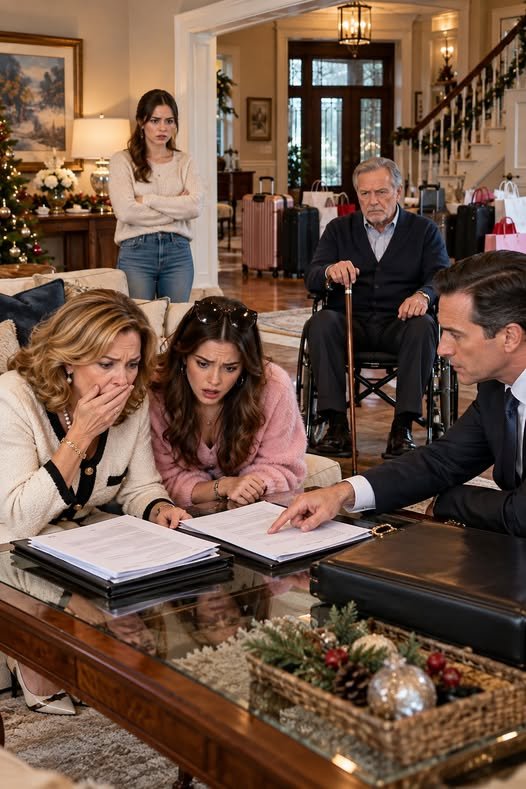
The living room was so still I could hear the radiator ticking. My mother sat with the packet trembling in her lap. Sabrina had stopped asking questions and was reading over her shoulder, her lips moving.
“Mr. Vance,” Dad said, “please explain it plainly. I’d like them to understand every word.”
Mr. Vance adjusted his glasses. “Page three is a notice of change to the Theodore Hale Family Trust. Robert’s late father left a substantial estate. Until five days ago, Mrs. Hale and Miss Sabrina were named as co-beneficiaries, to receive distributions on Robert’s decision. On Thursday, Robert, in the presence of a physician, a notary, and a witness, amended that trust.”
“Amended it how?” Mom whispered.
“Your names have been removed as beneficiaries. The entire estate, valued at just over four million dollars, now passes to a new trust for the benefit of Chelsea, with Robert’s care needs paid from it first.”
Sabrina made a strangled sound. “Four million? Dad, you never said…”
“No,” he said. “I didn’t.”
I hadn’t known the number. I sat on the arm of the couch, gripping the cushion.
“That’s not all,” Mr. Vance continued. “Joint credit cards in Mrs. Hale’s and Miss Sabrina’s names, which Robert funded, were closed Thursday morning. Your Hawaii charges, a little over thirty-one thousand dollars, were not paid by him. They will appear on your statements.”
Mom stood so fast the packet slid to the floor. “Robert, I’m your wife. After thirty years, you’d do this over one trip?”
Dad looked at her, and the calm in his face was worse than anger.
“Diane, I had a heart attack alone in a cold house. Chelsea found me by chance. The doctor said five more minutes and I’d be dead. You left a sticky note.” His voice stayed even. “That wasn’t one trip. That was the day I stopped making excuses.”
“I didn’t know it was that serious!”
“You didn’t ask. You left me with a note telling our daughter to take care of me. You didn’t call once in seven days.” He lifted his phone. “My call log is clean. Chelsea’s shows forty-one calls to you. Not one was returned.”
My mother’s mouth opened and closed.
Sabrina found her voice first, shrill and desperate. “This is Chelsea’s doing! She poisoned you against us while we were gone.”
“Sabrina.” Dad’s cane tapped the floor once. “Your sister did nothing but save my life. She didn’t know about the trust until Thursday. Don’t you dare.”
“But it’s ours! Grandpa would have wanted…”
“Your grandfather wrote in his will that the estate should go to whichever of his descendants showed that family meant more than money. He asked me to decide.” Dad’s eyes were wet now, though his voice held. “I waited years, hoping I’d be proud of my answer. Instead, I got the sticky note.”
Sabrina burst into tears. Not the performing kind. It was the stunned weeping of someone who has finally met a door that doesn’t open.
I spoke then, because I couldn’t stay silent any longer.
“Dad, I don’t want your money. I never did.”
“I know,” he said gently. “That’s exactly why it’s yours.”
“I can’t take everything from them.”
“You aren’t.” He looked at me. “I want you to hear the rest of the plan, and decide whether you can live with it. Mr. Vance.”
The attorney produced a final sheet. “Robert has made several provisions, subject to Chelsea’s agreement. First, Mrs. Hale and Miss Sabrina retain the right to remain in the family home for ninety days, to allow for an orderly transition. Second, a fund of sixty thousand dollars is set aside for each, to be released over two years toward housing and education, conditional on honest, documented effort: work, school, or training. Third, if either demonstrates, over time, a genuine change in conduct, the trustee, meaning Chelsea, may extend further help at her sole discretion.”
“It isn’t revenge,” Dad said. “It’s the first honest thing I’ve done for them in years. They’ve never had to earn anything.”
I looked at my mother, hunched on the sofa, mascara streaking her tan. I looked at my sister, small and frightened under her expensive highlights.
“I’ll accept it,” I said slowly. “On one condition. Mom and Sabrina decide whether they want that help. Nobody forces it on them.”
The silence stretched. Then Mom, hoarse, said, “Is Dad right? That I didn’t call?”
“You didn’t call,” I said.
She closed her eyes. When she opened them, something in her face had broken and, I thought, begun to rebuild.
“I told myself you’d manage,” she whispered. “You always did. It was easier to believe than to look.” She turned to my father. “Robert, I’m so sorry. I won’t ask you to forgive me. But I’d like the chance to be better.”
“Then start by taking care of the person you almost lost,” he said. “Without being told.”
She nodded, crying, and crossed the room to kneel beside his wheelchair. He didn’t embrace her. He let her take his hand.
It was Sabrina who surprised me.
She stayed on the couch for a long time, staring at the carpet. Then she stood, walked to the entryway, picked up her two suitcases, and carried them upstairs herself. When she came back down, she went to the kitchen and began washing the dishes I’d left in the sink, awkwardly, as though she had never seen a sponge.
“I don’t know how to do this,” she said, without turning around.
“Nobody does at first,” I said.
“I was horrible to you.”
“You were.”
“I’m going to try to stop.” Her shoulders shook. “Will you teach me?”
I took a dish towel from the hook. “Start by rinsing before you soap.”
She laughed, wet and shaky, and handed me a glass.
The next months were uneven. Mom moved her things into the guest room so Dad could keep the bedroom, and she learned to measure his medications and drive him to cardiac rehab. Sabrina took a job at a pet supply store and then enrolled in a community college program in veterinary technology. Some weeks she cried on the phone. Some weeks she called to say she’d passed an exam.
Dad recovered slowly. On his first walk around the block, he leaned on my arm and said, “I thought I’d raised two daughters who didn’t need me. It turns out I only raised one who did.”
“You raised both,” I said. “One of them just took longer.”
In June, I drove my parents to the cemetery where my grandfather lay. Dad set a small bouquet on the stone and stood a while with his cane.
“I hope I decided right, Dad,” he said quietly.
Behind us, my mother and Sabrina waited by the car, not intruding. When we returned, Sabrina held out an unopened envelope.
“Dad,” she said. “It’s my first paycheck from the clinic. It isn’t much.”
“What is it for?”
“For the bills, or for nothing. I just wanted to hand someone something I earned.”
He took it, and for the first time in many years, my father smiled without reservation.
On the drive home, I looked in the rearview mirror at the three of them in the back seat, tired and sunburned and quiet. Nobody was performing. Nobody asked me to carry anything.
I thought of the dark house and the gasping breath and the yellow note.
Then I turned on the radio, rolled down the window, and drove us home.